

Acupuncture
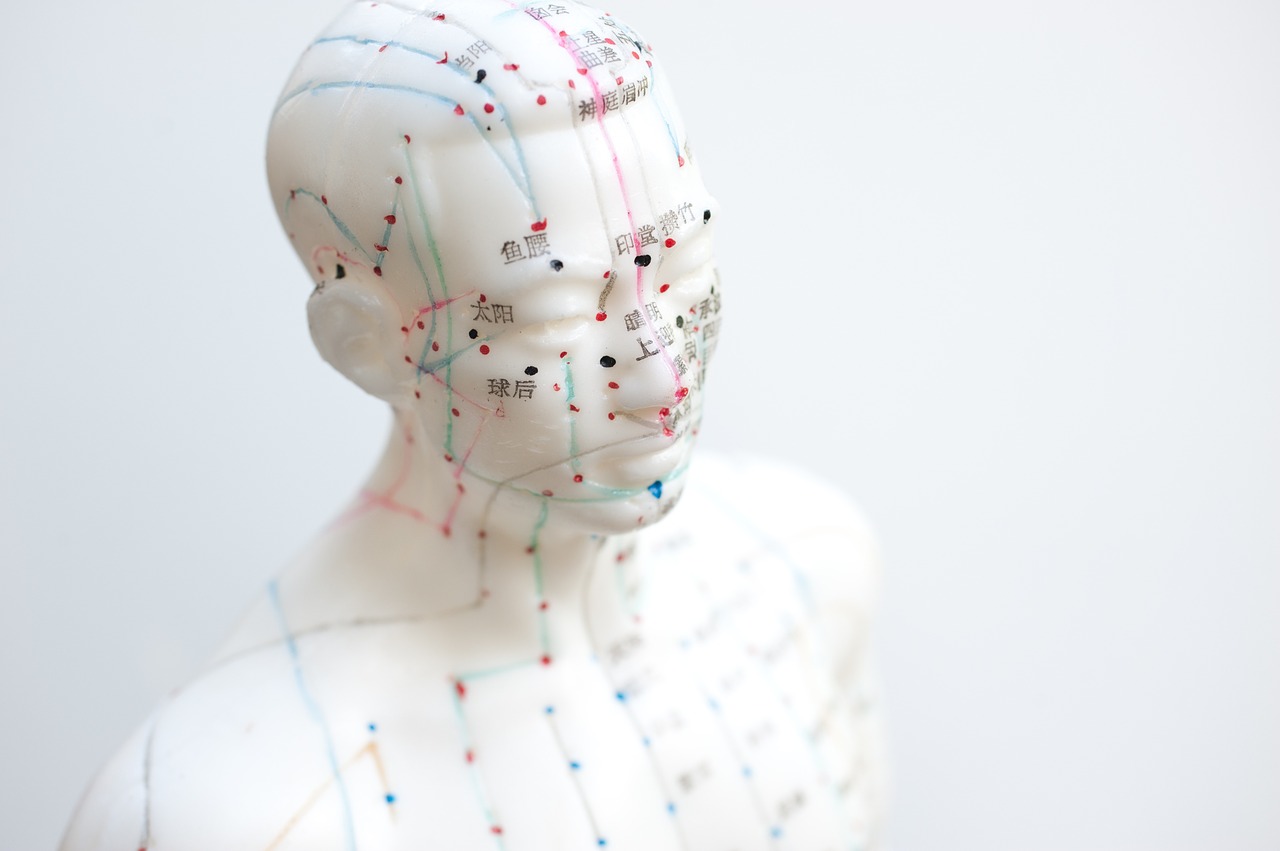
Acupuncture involves the stimulation of specific acupoints located all over the body. This is done in a number of ways — from inserting very fine needles into them, to heating them, to stimulating them electrically or with laser light, or even applying different therapeutic substances onto them. Which of these I use in my practice is determined by the details of each patient.
An ancient practice
The practice of acupuncture is ancient, its origins lost in the mists of antiquity. What we do know is that acupuncture points have been recognised for at least 5,300 years. We know this from the discovery of “Ötzi,” a man who died in the Alps around 3300 BC, whose frozen body was found by two hikers in 1991. His remarkably preserved remains carry 59 small tattoos, around 80% of which correspond exactly to the locations of modern acupuncture points. X-rays revealed that he had suffered from osteoarthritis of the lower spine — and many of the tattooed points are ones that would be used today to treat exactly that condition. Though acupuncture is thought of as an Eastern practice, Ötzi shows it was known in Europe more than five thousand years ago.
What it does, and how
That acupuncture does something, given how long and how widely it has been practised, is not seriously in doubt. But what it does, and how, is a question that has not yet been fully settled. There are mainly two accounts.
The first explains acupuncture through established physiology. It points to the close correspondence between acupoints and known anatomical structures — neurovascular nodes, rich in nerve fibres, fine blood and lymph vessels, and concentrations of mast cells. On this view, the small, controlled stimulus of a needle prompts a cascade of local and systemic responses: increased blood flow, the release of endorphins, activation of the immune system, and the release of exosomes — tiny vesicles that carry information between cells. Together, these bring about the relaxation, pain relief, and improved regulation that often follow.
The second is the traditional account, which frames acupuncture in terms of Qi — a term variously rendered as energy, breath, function, dynamism, or vitality. In this picture, Qi flows along defined pathways through the body, the meridians, with the acupoints situated along them. There are fourteen main pathways, each associated with a particular organ, and acupuncture is the art of regulating that flow.
These are often assumed to be competing explanations — the physiological one modern and respectable, the other an old metaphor. But that may be the wrong way to see it.
Coherence, convergence
In the broader renderings of Qi — function, dynamism, vitality — it points to the organised, coordinated activity of a living system. And when modern investigative tools are turned to the question of what Qi and meridians are, the traditional picture has tended to be corroborated rather than dissolved.
In a striking series of studies, the Korean researchers Kim Bong-han and Kwang-Sup Soh injected a radioactive tracer into acupoints and followed its movement. Rather than diffusing uniformly outward as you would expect, it travelled along the exact meridian lines described in the classical texts, even surfacing at the traditional acupoints — and when a channel was severed, the tracer stopped, as though running in a real conduit distinct from any known anatomical structure.
Acupoints have also been observed to have a characteristically low electrical resistance compared with the surrounding skin, as though connected by some conductive pathway, with the resistance between particular points shifting in states of disease. This property was studied from the 1950s by the German physician Reinhold Voll, whose work developed into a diagnostic method known as electroacupuncture according to Voll, which feeds directly into the bioresonance approaches I use in another part of my practice.
The biologists Mae-Wan Ho and David Knight have proposed that the meridians correspond to the body’s connective tissue itself — specifically to the liquid-crystalline lattice of collagen fibres and the structured layers of water bound to them, a continuum that runs throughout the body and conducts signals faster than the nerves. On this account, Qi is the coherent energy of that living matrix, and the meridians are its lines of communication. It is the same structured water, organised by living tissue, that underlies how I think about light therapy — and part of a larger picture in which living organisms turn out to be coherently organised right down to the molecular level.
The two accounts — traditional and modern — rather than competing, seem to be coherent and convergent. Each describes, in its own language, a self-regulating organism coordinated at every scale.
How I use it in practice
As with all scientific pursuits, there are surely still many things to discover about acupuncture that we haven’t even considered yet. But fortunately, we don’t have to wait until every detail is fully explained — we can already benefit from acupuncture by drawing on the collective knowledge and experience of thousands of practitioners over thousands of years, as well as the constantly advancing insights of modern science.
Acupuncture is one of several tools I draw on rather than the centre of my practice. Whether it’s applicable to your situation, and which methods of stimulation to use, is something we’d consider together in consultation.
Working together
If you’d like to discuss whether acupuncture might be relevant to what you’re dealing with, the next step is a consultation. Book a consultation — or get in touch with any questions first.