

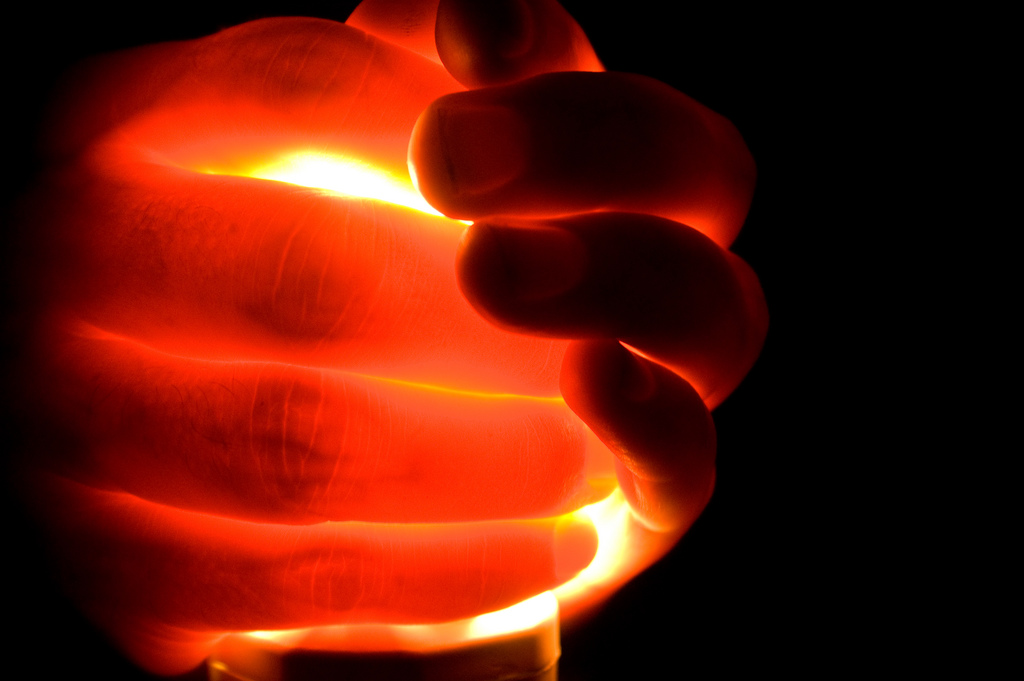
Light therapy
Light is one of the most fundamental influences on the body. Beyond letting us see, it acts directly on our cells and sets the daily and seasonal rhythms our physiology is organised around. Used deliberately, light is also a therapeutic tool — and red and near-infrared light in particular is among the better-researched approaches in this area, with several thousand laboratory and clinical studies published to date. Red and near-infrared light is the form I use most in practice.
Red and near-infrared light
Red and near-infrared light has a direct effect on the energy-producing machinery of living tissue. It’s absorbed by cytochrome c oxidase — the enzyme at the very end of the mitochondrial electron transport chain, where oxygen is consumed and the bulk of our energy is produced. More precisely, the light energy is received by the copper atoms held within that enzyme: the entry point is submolecular, and the effect ripples outward from there.
Because this final step is a rate-limiting one for the whole chain, supporting it has a much more meaningful effect than might be expected: it eases the bottleneck that governs how efficiently energy can be produced. And because energy and structure sustain each other — better energy helps maintain and refine structure, and that improved structure in turn produces energy more effectively — a small push at this step can feed a cycle that lifts the whole. This reciprocity isn’t particular to one scale. It holds for the enzyme, for the mitochondrion that houses it, for the cell, the tissue, the organ, and the person — each level’s order maintained by the energy flowing through it, and each level’s capacity to produce that energy depending on its order being intact. A change introduced at the smallest scale propagates upward through all of them. This is the same understanding that runs through the rest of how I think about health, and it’s why the effect of improved energetics tends to show up broadly, as healing and resilience.
That mitochondrial effect is one specific way light acts on living tissue, but it’s certainly not the only one. The physiologist Ray Peat described light (especially in the red part of the spectrum) as a fundamentally pro-metabolic, anti-stress influence — something the body is designed to receive continuously, and the absence of which is itself a kind of stress. On this view, light isn’t so much an intervention as the restoration of the environment our physiology expects, nudging metabolism back toward the efficient, energy-producing state that characterises health.
Another line of thinking concerns the water inside our bodies. The bioengineer Gerald Pollack has shown that water in association with living tissue organises itself into a structured, charge-separated liquid crystal matrix with unique properties. He has observed that infrared light promotes the structuring and extent of this organised water. This structured water is able to hold and deliver energy much like a battery, and it may help move blood and fluids smoothly through the body. It’s a fascinating and far-reaching idea and it points in the same direction as everything else here: light helping to organise and energise the watery interior of living things. It’s the same body of research that helps inform how the ionic footbath I use in my practice is understood.
When it comes to the therapeutic use of red and infrared light, the two parts of this spectrum behave somewhat differently. Red light (roughly 610–700 nm) is absorbed in the skin and more superficial tissues and is more applicable for issues close to the exterior of the body. Near-infrared light (roughly 700–850 nm) is typically able to reach further into the body — into muscle, joints, and bone. The research base across both is substantial and still growing: the strongest human evidence sits in specific areas — skin health and wound healing, certain kinds of musculoskeletal and joint pain, tissue recovery — while a much wider range of applications is under active investigation. The breadth of conditions for which red and infrared light has shown benefit in research is genuinely striking.
How I use light in practice
Red and near-infrared light is safe, non-invasive, and well tolerated, which makes it a useful tool to combine with other elements of a treatment plan. The device I use delivers the red and near-infrared wavelengths that the research centres on.
A session simply involves exposing the relevant area of the body to the light for a few minutes. Nothing is felt beyond gentle warmth, and there is no recovery time. Whether it’s relevant to your situation, and how it would fit alongside the rest of your treatment plan, is something we’d decide together in consultation.
Beyond therapeutic light applied clinically, part of your treatment plan will usually also involve optimising your everyday light environment — the natural and artificial light you live and work in — since this shapes your physiology continuously, day in and day out.
Working together
If you’d like to discuss whether light therapy might be relevant to what you’re dealing with, the next step is a consultation. Book a consultation — or get in touch with any questions first.